BHAGAVAD GĪTĀ
The Beloved Lord’s Secret Love Song

Click here to Purchase on Amazon
“Graham Schweig’s new, beautiful, and accessible translation will remain the standard text of this marvelous Song for years to come, if it is ever to be superseded.”
–Huston Smith, author of The World’s Religions
“Crystal clear and eminently readable.”
–Ariel Glucklich, Professor of Theology at Georgetown University
“The Bhagavad Gita is a religious classic; Graham Schweig’s felicitous translation deserves to be called a classic in its own right.”
–Arvind Sharma, Birks Professor of Comparative Religion at McGill University
“Schweig has produced a beautifully readable, accurate and respectful translation that should become the standard text for classroom use.”
–John Borelli, author of Interfaith Dialogue
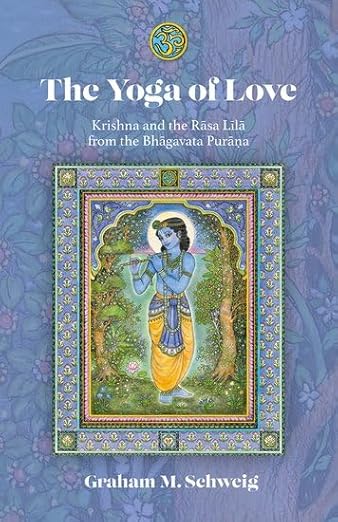
YOGA OF LOVE
Krishna and the Rāsa Līlā from the Bhāgavata Purāna
Click Here to Purchase on Amazon
DANCE OF DIVINE LOVE
The Rāsa Līlā from the Bhāgavata Purāṇa

Click Here to Purchase on Amazon
“This is truly first-rate scholarship. The five-chapter dramatic poem of the Rasa Lila is a gem of world literature, and Schweig has polished it masterfully. His translation gives a sense of the poetic aspect of the work as well as its theology.”
–E. F. Bryant, Rutgers University
“Schweig’s translation is accurate, expressive, and poetic. This book will be useful to classes in a variety of disciplines, including world literature, Eastern religions, and comparative art and culture.”
–June McDaniel, College of Charleston
“A comprehensive presentation of the Rasa Lila chapters from the Bhagavata Purana has been much awaited, and this volume by Dr. Graham Schweig will surely satisfy scholars and aesthetes alike. Dr. Schweig’s knowledgeable mind has danced well with his sensitive heart to produce a great accomplishment.”
–Acharya Shrivatsa Goswami, Radha Raman Temple, Vrindavana, India and author of Celebrating Krishna
A LIVING THEOLOGY OF KRISHNA BHAKTI
Essential Teachings of A.C. Bhaktivedanta Swami Prabhupāda

Click here to Purchase on Amazon
“This is a labor of love-by Julius Lipner and Graham Schweig in preparing an unfinished manuscript for publication, and by Goswami in bringing specifically the theological work of his guru, Prabhupada, into mainstream academic discourse. I remember discussing this project with Goswami; he worried that his treatment of Prabhupada might discomfit ISKCON devotees and yet delighted in highlighting Prabhupada’s brilliant Vaishnava theologizing. I can see Goswami’s sweet smile as he ponders this book-a book that now embodies his creative, amazing life.”
—Rachel Fell McDermott, Professor of Asian and Middle Eastern Cultures, Barnard College
“A Living Theology of Krishna Bhakti is a poignant testimony to the erudition and creativity of Tamal Krishna Goswami and to his dedication to drawing forth fresh insights from the traditions of Gaudiya Vaishnavism and Swami Prabhupada’s ISKCON. We learn a great deal about the Vaishnava theological tradition and about how to think theologically about Krishna with attention to history and circumstances, and with sensitivity to the age in which we live. Goswami’s work is valuable even in its incompleteness, making the case for a living Hindu theology that speaks to today’s world. It is also a tribute to Graham M. Schweig–Tamal Krishna’s friend, compatriot, posthumous editor–who brought the work into print and also offers concluding insights that humbly round out Goswami’s bold plan.”
—Francis X. Clooney, SJ, Harvard University
“Tamal Krishna Goswami’s A Living Theology of Krishna Bhakti is an illuminating theological analysis of the life and teachings of his own guru, A. C. Bhaktivedanta Swami Prabhupada. Through this work Goswami, as a master mediator between religious and academic worlds, helps open the Hindu studies guild to new voices and alternative discourses and challenges us in the academy to provide hermeneutical and institutional space for the contributions of scholar-practitioners. Graham Schweig is to be commended for all of his efforts in completing Goswami’s work and bringing out this valuable study.”
—Barbara A. Holdrege, Professor of Religious Studies, University of California, Santa Barbara
BHAGAVAD GĪTĀ CONCORDANCE
A Comprehensive Word Reference with English and Sanskrit Indexes

“Graham M. Schweig’s Bhagavad Gītā Concordance is the best work of its kind for all of Sanskrit literature. It is comprehensive, precise, and astonishingly user-friendly. No future translation of the Gītā or scholarly study of its language, philosophy, or theology can proceed without consulting this concordance.” — Ariel Glucklich, professor and chair of theology and religious studies, Georgetown University
“Bhagavad Gītā Concordance fills a major lacuna in scholarship and will become a standard reference book and resource for millions of scholars and practitioners. Graham Schweig’s translation of the Bhagavad Gītāis a masterpiece, and this concordance is impeccably done.” — Gopal K. Gupta, author of Māyā in the Bhāgavata Purāṇa: Human Suffering and Divine Play
“Schweig’s comprehensive and utterly useful concordance of the Bhagavad Gītā is astonishingly the first of its kind, even though there have been other related reference works that precede it. Recollecting even a single word, phrase, or idea from the Gītā―a monumental and oft-memorized work of Indian philosophy and culture―both the scholarly and general reader can now easily consult this concordance to bountiful results.” — Deven M. Patel, author of Text to Tradition: The Naiṣadhīyacarita and Literary Community in South Asia
“The Bhagavad Gītāserves as the gateway for understanding the core principles and practices of Hindu Yoga. This remarkable concordance serves at least two purposes. First, it allows one to navigate all the complex and well chosen terms that define key ideas in the text. Second, it helps broaden one’s grasp of the Sanskrit language, tracing the root origins of words and their many derivations. This book is essential for all university libraries and for all intermediate Sanskrit seminars.” — Christopher Key Chapple, Doshi Professor of Indic and Comparative Theology, Loyola Marymount University
“Graham Schweig has lovingly and comprehensively put together the ultimate concordance of the Bhagavad Gītā. It is not just a list of words and other lexical items that are easily located in the main text, but the volume also includes several useful appendices of themes, Sanskrit-English and English-Sanskrit vocabulary along with four well-received translations of the Sanskrit-English vocabulary, a list of Sanskrit nominal stems and verbal roots, and the entire text in Roman transcription. This is an indispensable resource for students and lay readers who seek a better grasp of this supremely important Indian text.” — Frederick M. Smith, professor emeritus of Sanskrit and classical Indian religions, University of Iowa
POSTHUMOUS EDITING OF A GREAT MASTER’S WORK
Special Focus on the Writings of A. C. Bhaktivedanta Swami Prabhupāda

Edited by Graham M. Schweig
Contributions by Edith Best; Jonathan Edelmann; Joseph Fedorowsky; Austin Gordon; Michael Gressett; Barbara A. Holdrege; Allan M. Keislar; Anna S. King; Julius Lipner; Jeffery D. Long; Kenneth Rose and Graham M. Schweig
“Rarely does an academic work speak with such urgency and clarity to an issue that concerns millions of readers around the world. This book is a work of interdisciplinary scholarship that brings together theologians, historians, educators, an attorney, as well as practitioners and scholars of religion, to shed light on the extensive and unwarranted editing of the works of A.C. Bhaktivedanta Swami Prabhupada by the Bhaktivedanta Book Trust.”
— Abeer Saha, Curator, National Museum of American History, Smithsonian Institution
“Śrīla Prabhupāda was one of the more significant Indians to bring Hindu devotional thought and practice to the west in the 1960s and 70s. Since that time, ISKCON–the organization he founded–has spread all over the world as have many of his teachings. The topic of the present volume then, deals with issues that are not only important to Prabhupāda’s followers but to scholars and lay people interested in his approach to Krishna devotion in the Hindu Tradition. Like several of the contributors to the volume, I am not a member of his organization, although I met with Prabhupāda on several occasions and have read many of his writings. In addition, I participated in the conference at GTU in 2020 that generated many of the chapters herein. Each of these bring light to the discussion of the dynamics of translating and editing the work of significant authors as well as of one’s own spiritual teacher. Several mention the principle of arsa-prayoga, which is generally understood to mean that the quality and wisdom of a spiritual teacher’s words can outweigh whatever grammatical errors he/she might make. In some form or another, this concept of accepting their guru’s words just as they have been spoken tends to be adhered to by many followers of Hindu teachers as a way of showing deference and respect. This appears to be the case with many of the contributors to this volume as they adopt and apply this principle to the transcribed versions of Prabhupāda’s writings. In doing so, they display sound and rational thought in the process of expressing both their understandings of the issue as well as their devotion. Although the volume is an important contribution to the specific situation being discussed, it also provides the reader a broader perspective on the difficulties that can and do arise when attempting to “edit” the words of a posthumous author of respect.”
— Ramdas Lamb, University of Hawai’i at Manoa
“The status of a spiritual mission, including the words of the founder, may be judged by the quality of academic debate that ensues in its aftermath. The international success of ISKCON and the writings of His Divine Grace A. C. Bhaktivedanta Swami Prabhupada (1896-1977) are at the forefront of the wave of Indian spirituality that changed the way the entire world thought about theistic Hinduism and Bhakti devotion to Krishna. And while the essential message may remain strong among the devotees, I applaud Graham Schweig and the contributors of this engaging volume for bringing to light many of the scholastic issues involved in the ongoing republication of Prabhupada’s written teachings and am confident it will generate valuable insight into sacred texts and the literary experience of the Holy.”
— Guy L. Beck, Tulane University Asian Studies
 Garuda Das Kavirāja